Reading from figured bass

The following article by Clifford Bartlett is a good introduction to 17th century figured bass (or thorough bass as it was known). It has been printed in a number of King's Music editions, particularly of vocal music by Monteverdi. The article appears here by permission of the author.
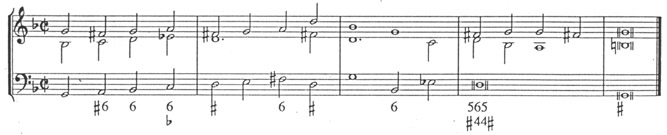
Nearly all King's Music (now Early Music Company) publications assume that keyboard or lute continuo players can read from a figured bass part. This is now expected of professional players specialising in this repertoire; but it is not a difficult skill and non-specialists and amateurs will find that, with surprisingly little practice, they can also play without the interference of a modern realisation. All that is required is some knowledge of elementary harmony and confidence.
It is best to start with early 17th century music, where figuring is
sparse and the choice of chords usually simple, before trying quicker-moving
and more complicated music of the later baroque. Our series of 17th
century music for one and two voices is particularly suitable: the original
figuring is supplemented editorially and occasionally problems are discussed
in the editorial notes. Generally, we do not give figures for chords
obvious from the voice parts.
The most useful short guides are by Wendy
Hancock "General Rules for Realising an Unfigured Bass in Seventeenth
Century England" Chelys, vii, 1977, pp. 69-72; and by Stephen Bonta
in vol. 1 of "The Instrumental Music of Giovanni Legrenzi", Harvard University
Press, 1984, pp. xviii-xxxiv. Extensive extracts from early writers
are translated in F.T. Arnold The Art of Accompaniment from a Thorough-Bass,
O.U.P., 1931, repr. Dover Books. Beware of applying rules from a later
period. Realised editions are too often a bad model, but the harmonic
language of a composer can be absorbed by playing his more fully-scored
music.
Early 17th century music needs very few figures, since players had certain expectations from the relation of a bass note to the tonic. Sharp or flat signs are used to indicate major and minor chords that contradict the key signature. Normally, play a triad on the tonic, dominant and subdominant, a first inversion on other notes (though the submediant may need a triad); a sharpened bass note also requires a first inversion. In later music, however, all unfigured chords are assumed to be triads. Figures indicate the interval above the bass of the note which characterises the chord. 6 stands for a first inversion, 6/4 for a second inversion. A line through a figure usually indicates that it is sharpened, (though sometimes a line through 5 stands for a diminished fifth). Figures above each other refer to one chord, adjacent figures to consecutive chords. When the bass has short notes, it is often only necessary to play chords on the main beats, perhaps supplemented by thirds or tenths with the bass.
The penultimate dominant chord of a perfect cadence is always major; elaborations of it (eg. 43, 3443, etc.) are often not figured. A cadence from supertonic to tonic can imply either 56 or 76. For most of the 17th century the closing chord is always major. (Many performances and editions wrongly give minor chords; if a major chord sounds obtrusive, it is better to play a unison.)
Avoid consecutive octaves and fifths between the top part of your right hand and the bass (best done by playing in contrary motion or thirds whenever possible). Play simple chords, rarely moving the right hand separately from the bass. Let the voice clash against the chord if it moves at a different time from the bass. If playing a harpsichord or lute, try to sustain like an organ, but if playing an organ, avoid continuous legato and try to sound more like a harpsichord. Vary dynamics by the thickness and position of chords, not by changing registration. Keep the right hand low: the E a tenth above middle C is the highest you should go. Stay below the part you are accompanying. Remember that, whatever problems you are having thinking about the chords, your main function is to play the bass and that rhythmic precision and vitality are more impoartant than the actual notes you play. Phrase with the voice and the other instruments (though it should not be assumed that melodic bass instruments are necessary).
The sample at the top of the page shows a scale and a cadence. It could appear in a 17th century piece without figuring except for the 6 under the fourth note and perhaps 43 under the penultimate note. Without the figuring, the fourth note presents the only ambiguity. The flattening of the third is made on the assumption that the composer was thinking in terms of G minor, despite the one-flat signature, and that the change to the D major of the next bar should not be anticipated. Playing a simple triad here, even if the voice is singing A, would produce a 6/5/3 chord, which is perfectly acceptable. (The harmonic terminology used here is anachronistic, but seems to accord with the mental processes required to play 17th century bass parts).
© Clifford Bartlett
Early Music Company, UK